
Introduction
Coconut water is the clear liquid found inside young, green coconuts. Unlike coconut milk -- which is pressed from the flesh -- coconut water is a naturally occurring fluid with a composition that closely resembles the electrolyte profile of human plasma, making it one of the few plant-based beverages with genuine rehydration credentials.
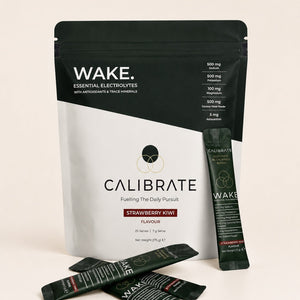
Its primary electrolytes are potassium, sodium, magnesium, calcium, and phosphorus. A standard 240ml serving provides approximately 600mg of potassium, alongside sodium, magnesium, and chloride, making it a naturally rich electrolyte matrix without artificial additives. CALIBRATE uses coconut water as a whole-food electrolyte source within WAKE, complementing the precision-dosed electrolytes already in the formula.
Coconut water is one of the only plant-based beverages with a naturally occurring electrolyte profile close enough to human plasma to be studied as a clinical rehydration agent.
Electrolyte Composition and Rehydration
The case for coconut water in sports nutrition rests primarily on its role as a natural electrolyte source. Research has consistently shown it to be comparable to commercial sports drinks for rehydration following exercise.
A landmark study by Ismail et al. (2007) examined rehydration in ten healthy male subjects who lost 3% of body weight through 90 minutes of running at 65% VO2max in a 32 degree Celsius environment. During a two-hour rehydration period, subjects consumed plain water, a sports drink, fresh coconut water, or sodium-enriched coconut water. The results showed coconut water produced a fluid retention rate of 71.05% compared to 71.29% for the sports drink and only 55.95% for plain water -- a statistically equivalent performance to the commercial product, and both significantly better than water alone.
Kalman et al. (2012) expanded on this in a randomised trial of 12 exercise-trained men who consumed water, coconut water, coconut water from concentrate, or a carbohydrate-electrolyte sports drink following 60 minutes of dehydrating treadmill exercise. No significant differences were found between any beverage conditions for measures of fluid retention or exercise performance.
A 2023 randomised crossover trial by Paton (Sports) assessed 19 experienced cyclists consuming either coconut water or a commercially available sports drink during 90 minutes of sub-maximal cycling at 70% peak power output, followed by a simulated 20km time trial. Analysis of blood glucose, lactate, sweat loss, heart rate, time trial performance, and average power found no significant differences (p greater than or equal to 0.05) between conditions for any measured variable. Effect sizes were trivial across all outcomes (Cohen's d less than or equal to 0.2). The study concluded that coconut water had a similar effect on cycling time trial performance and physiological responses to consuming a commercially available sports drink (Paton, 2023).
Natural Bioactive Compounds
Beyond electrolytes, coconut water contains naturally occurring cytokinins (plant hormones with antioxidant properties), phenolic compounds, and trace amounts of B vitamins including riboflavin, niacin, and pantothenic acid.
The phenolic content of coconut water contributes to its antioxidant activity. A study published in Molecules (Yong et al., 2009) characterised the phenolic profile of coconut water and identified compounds including caffeic acid, shikimic acid, and several flavonoids, with measurable antioxidant capacity via DPPH and FRAP assays. While coconut water is not a primary antioxidant supplement, these compounds add to the overall nutritional value of the matrix.
Rehydration vs Hydration During Exercise
It is worth distinguishing between two different applications that the research addresses. Most coconut water rehydration studies examine post-exercise recovery -- replacing fluid and electrolytes lost during a bout of exercise. In this context, the evidence is consistent: coconut water performs comparably to sports drinks.
For rehydration during prolonged exercise, coconut water's relatively lower sodium content compared to most commercial sports drinks is a relevant consideration. Sodium is the primary driver of thirst and fluid retention during exercise and plays a critical role in preventing hyponatraemia in endurance events. CALIBRATE supplements the natural sodium content of coconut water with additional sodium in its WAKE formulation to ensure the sodium:potassium ratio is optimised for in-exercise hydration as well as recovery.
Whole-Food Philosophy
From a formulation standpoint, coconut water represents CALIBRATE's broader philosophy: where possible, source electrolytes and micronutrients from whole-food matrices rather than entirely synthetic pathways. The advantage of a whole-food ingredient is that it carries co-factors and compounds that isolated minerals cannot replicate -- the cytokinins, phenolics, and natural enzyme activity present in coconut water contribute to a more complete nutritional input than a pure potassium salt alone.
Conclusion
Coconut water brings a naturally occurring electrolyte matrix to WAKE that has been validated across multiple controlled trials as equivalent to commercial sports drinks for rehydration. Its potassium richness, trace mineral content, and naturally occurring bioactive compounds make it a functionally sound whole-food electrolyte source. Within CALIBRATE's formulation, it works in concert with precision-dosed sodium, potassium, and magnesium citrate -- providing a natural nutritional foundation to which targeted supplementation is applied.
References
Ismail, I., Singh, R., and Sirisinghe, R. G. (2007). Rehydration with sodium-enriched coconut water after exercise-induced dehydration. Southeast Asian Journal of Tropical Medicine and Public Health, 38(4), 769-785.
Kalman, D. S., Feldman, S., Krieger, D. R., and Bloomer, R. J. (2012). Comparison of coconut water and a carbohydrate-electrolyte sport drink on measures of hydration and physical performance in exercise-trained men. Journal of the International Society of Sports Nutrition, 9(1), 1. https://doi.org/10.1186/1550-2783-9-1
Paton, C. D. (2023). Coconut Water: A Sports Drink Alternative? Sports, 11(9), 183. https://doi.org/10.3390/sports11090183
Saat, M., Singh, R., Sirisinghe, R. G., and Nawawi, M. (2002). Rehydration after exercise with fresh young coconut water, carbohydrate-electrolyte beverage and plain water. Journal of Physiological Anthropology and Applied Human Science, 21(2), 93-104.
Yong, J. W. H., Ge, L., Ng, Y. F., and Tan, S. N. (2009). The chemical composition and biological properties of coconut (Cocos nucifera L.) water. Molecules, 14(12), 5144-5164. https://doi.org/10.3390/molecules14125144
Alleyne, T., Roache, S., Thomas, C., and Shirley, A. (2005). The control of hypertension by use of coconut water and mauby: two tropical food drinks. West Indian Medical Journal, 54(1), 3-8.